
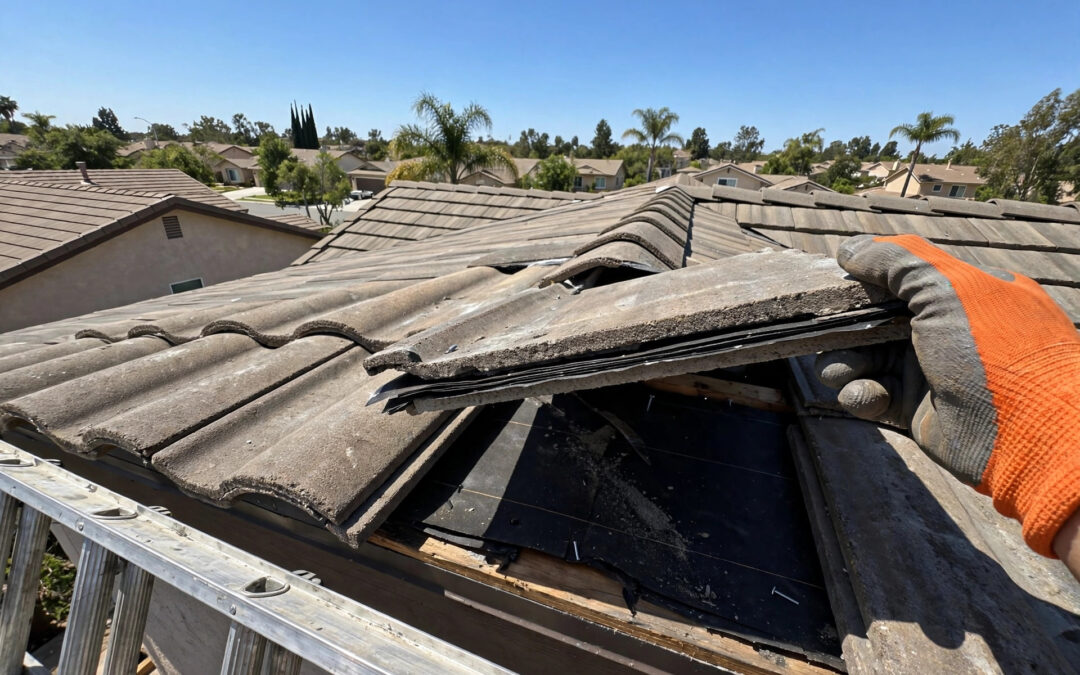
Banning sits in the San Gorgonio Pass, where desert heat and strong seasonal winds shape what covers local homes. Two roofing systems dominate the Banning market — concrete tile and composition (asphalt) shingle — and each has its own failure patterns that a roof certification inspection is designed to catch. Here is what our inspectors look for on each type.
Concrete tile roofs
Tile is everywhere on Banning's newer subdivisions and many mid-century homes. Tile itself can last for decades — the tiles are not usually the problem. What certification inspects most closely on a tile roof is everything underneath and between the tiles:
- Underlayment condition. The tile is a beautiful shell; the underlayment beneath it is the real waterproofing. Banning's intense summer heat bakes underlayment over time, and we check for deterioration at valleys, penetrations, and eaves where it shows first.
- Slipped, cracked, and missing tiles. Wind through the pass can lift tiles that were never properly fastened, and foot traffic during other service work cracks them. Even a single displaced tile exposes the underlayment to direct sun and weather.
- Flashing and valleys. The metalwork where the roof meets walls, chimneys, and vents is a common leak point. We look for rust, separation, and sealant failure.
- Ridge and hip caps. Wind gusts work these loose over time. Cracked mortar or separated caps get flagged.
Composition shingle roofs
Older Banning homes are more likely to carry composition shingles, which are more vulnerable to the pass climate:
- Heat aging. Sustained high temperatures accelerate granule loss and curling. We examine shingle edges for brittleness and cupping that signals the roof is nearing the end of its service life.
- Wind damage. Pass winds can crease or tear shingles, especially along ridges and rake edges. Lifted shingle tabs create entry points for driven rain.
- Fastener and seal failure. Shingles whose seal strips have failed may look intact on a calm day but lift in the next windstorm. Our inspectors physically check seal integrity in suspect areas.
- Valley and penetration wear. Skylights, vents, and plumbing stacks are stress points where sealant and flashing age faster than the field of the roof.
What a certification actually delivers
A roof certification is not a guess about roof age — it is a documented inspection of current condition against clear criteria. Our report identifies what passes, what needs repair, and what is at end of life, giving buyers, sellers, insurers, and HOAs a defensible basis for decisions about the roof.
Why Banning's climate makes this urgent
Heat and wind are the two biggest roof killers in the pass, and both are constant here. A roof that looked fine a few years ago can deteriorate fast under that combination. Certification catches the shift early — before the next wind event turns a small problem into an interior leak.
Get your Banning roof certified
Banning roof certification from our NRCIA-certified inspectors gives you a clear, honest condition report on your roof. Call 310.880.9718 to schedule your inspection today.