
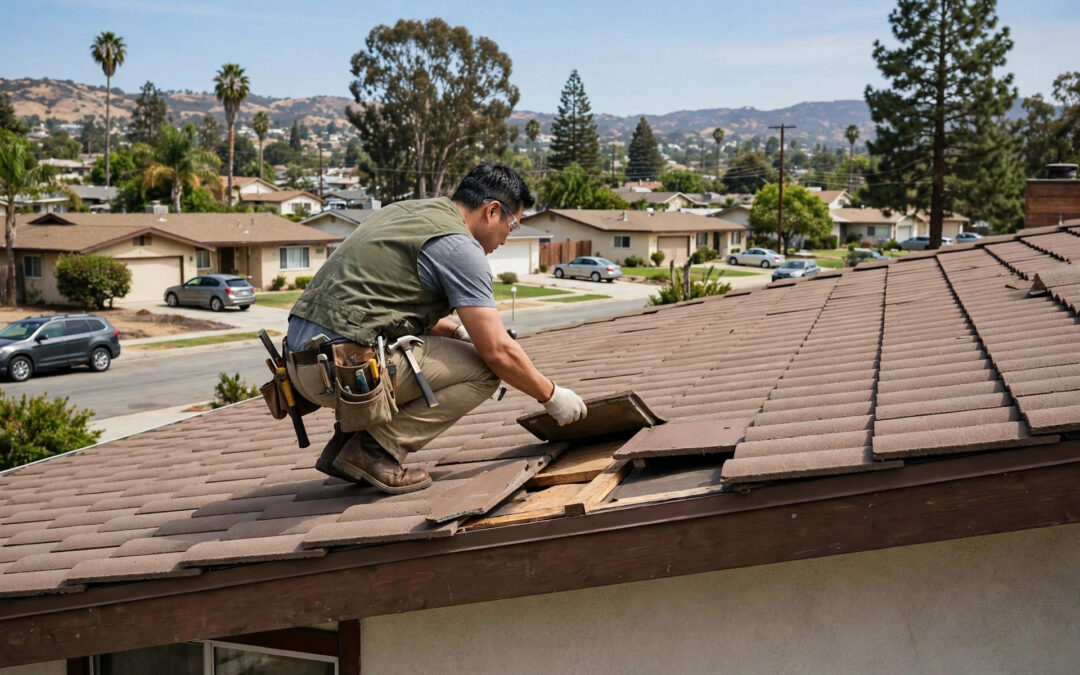
A roof certification is only as good as the inspection behind it. When our NRCIA-certified inspectors walk an Alhambra roof, we follow a methodical checklist tuned to the realities of this city: mid-century housing stock, a lot of concrete and clay tile, and the seasonal Santa Ana winds that test every roof in the San Gabriel Valley. Here is what we are actually looking at up there.
Tile Roofing: Alhambra's Most Common Covering
Many Alhambra homes wear concrete or clay tile roofs, and tile itself is remarkably durable — the tiles can outlast the structure beneath them. But tile roofs fail in specific, predictable ways, and our inspectors know exactly where to look.
Tile slippage is the big one. Individual tiles can shift or slide out of position over time, especially after wind events or seismic movement, leaving the underlayment exposed to sun and rain. We also look for cracked or broken tiles from foot traffic or fallen branches, and for tiles that have lost their fastening and can rattle or lift. A single slipped tile is a minor fix; a roof full of them is a different story, and certification depends on knowing the difference.
Underlayment: The Hidden Layer That Does the Real Work
Here is something most homeowners do not realize: on a tile roof, the tile is the sunscreen, but the underlayment is the waterproofing. The felt or synthetic membrane beneath the tiles is what actually keeps water out. In Alhambra, we see a lot of roofs where the original organic felt underlayment is nearing the end of its life — it becomes brittle, tears at the fasteners, and loses its ability to shed water.
Our inspectors check the condition of the underlayment wherever it is visible: at eaves, in valleys, around penetrations, and anywhere tiles are missing or displaced. When underlayment is deteriorated, a roof can look fine from the street while being unable to survive a real storm. That is exactly the kind of hidden problem a certification inspection is meant to catch.
Wind Lift and Edge Details
Santa Ana wind events are a fact of life in the San Gabriel Valley, and they punish roofs with weak edge details. Our inspectors pay close attention to the eaves, rakes, ridges, and hips — the places where wind gets its leverage. We look for loose ridge tiles, missing bird-stop or eave closures, and fasteners that have backed out over the years.
On older tile roofs, we also check whether the installation meets modern fastening expectations. Tiles installed decades ago may rely on methods that were standard then but would not pass muster today. We are not there to condemn old roofs — we are there to assess whether this roof, as it sits right now, can be certified as watertight for the certification period.
Flashing, Valleys, and Penetrations
Wherever the roof is interrupted, water wants in. Our inspectors examine the flashing around chimneys, skylights, and vents, the condition of valley metal or woven tile valleys, and the sealant at every pipe penetration. On Alhambra's mid-century homes, we commonly find original flashing that has corroded or sealant that has dried and cracked. These are small details with outsized consequences — a failed flashing can let in more water than a dozen slipped tiles.
We also check the drainage: gutters, downspouts, and the roof's overall ability to shed water. A certified roof is not just leak-free today; it has to move water properly when the next storm arrives.
The Rest of the Roof System
Beyond the covering itself, our inspection covers the roof's structure and support systems: signs of sagging or deflection in the deck, evidence of past leaks in the attic space (stains, damaged decking, mold), and the condition of fascia and eave wood. For certification purposes, we need the whole system to be sound, not just the visible surface.
What "Certification-Ready" Looks Like
A roof does not need to be new to be certified. Many Alhambra roofs we inspect are decades old and still earn certification after targeted repairs: re-securing slipped tiles, replacing failed underlayment in vulnerable areas, renewing flashing, and sealing penetrations. Our written report documents everything we found, what needs attention, and whether the roof qualifies — with no pressure and no sales pitch.
If you are buying or selling a home in Alhambra and the transaction hinges on the roof, this is the inspection that gives everyone confidence. Learn more about our roof certification services in Alhambra, CA, then call Get Your Roof Certified at 310.880.9718 to schedule your NRCIA inspection.